 A BIT OF HISTORY:
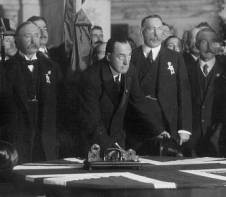
In September 1914, the Ulster Division was formed from the Ulster Volunteer Force which raised thirteen battalions for the three Irish regiments based in Ulster; the Royal Inniskilling Fusiliers, the Royal Irish Fusiliers and the Royal Irish Rifles.
In Ireland, a unique situation existed. This summary is from Ray Westlake’s “Kitchener’s Army”:
“It took several weeks after war was declared that permission to form an Ulster Division was granted. The Ulster Volunteer Force, a Protestant organisation created by Sir Edward Carson as a force to counter the threat of the Home Rule Bill, was already in existence and its members were as eager as any to join the war. However, due to the political situation in Ireland, things were held up. Many volunteers refused to wait and either crossed to England or Scotland to enlist, or joined the 10th or 16th Divisions already being formed by the War Office in Ireland.
With over 80,000 members, it was clear that the UVF was in a position to make an important contribution to the recruitment of the New Armies. Lord Kitchener met with Sir Edward Carson in London who, although eager to help was concerned at how the situation in Ireland might turn while his force was away at war. The Government were not able to give any guarantees that might put Sir Edward’s mind at rest. However, he later agreed to raise a Division, without any conditions, and within days had placed an order for 10,000 uniforms with a London firm of outfitters.”
The UVF was not only organised, but trained to some extent as a military force, and had been armed. It was therefore considerably more advanced as a formed body of men than the similar formations of the New Armies now being created elsewhere".
These battalions were clothed and administered by their raisers in the same way as the locally raised New Army battalions in Great Britain, although the UVF was at a high state of readiness in August 1914 as a result of heightened tensions in connection with the Home Rule debate that had occurred earlier in the year.
August 1914 : Formed in Ireland, as the Ulster Division, with Brigades numbered 1,2 and 3. On 28 August 1914, the Division and its Brigades adopted the titles shown here.
In July 1915, the Division moved to Seaford, on the Sussex coast of England. This was the first time that many of the men had been outside their native Ireland. Kitchener inspected the Division there on 27 July 1915, and later remarked to Carson “your Division of Ulstermen is the finest I have yet seen”. Another inspection took place, by His Majesty King George V, on 30 September 1915.
3rd to 6th October 1915 : moved to France, and served with distinction on the Western Front throughout the war. The Divisional Artillery remained in England until November 1915.
The Ulster Division initially concentrated in the area around Flesselles, some ten miles north of Arras. Gradually, men were sent in groups for familiarisation with trench warfare conditions, and were attached to the regular army 4th Division for the purpose in the (at this time) quiet are north of the River Ancre near Albert.
On 21 October 1915, the Division was moved away from the fighting area, towards Abbeville, where it spent most of the winter of 1915-16 continuing training. One of the Brigades was attached to 4th Division for several weeks at this time, and the artillery finally joined in late November.
The whole Division finally took over a complete section of the front line on 7 February 1916, between the River Ancre and the Mailly-Maillet to Serre road. Division HQ was at Acheux. The next six weeks were quiet enough, but punctuated by mine explosions, sniping, many patrols and similar small-scale incidents.
In the first week of March, the Division extended its front, the 109th Brigade taking over the sector south of the Ancre, known by the name of Thiepval Wood. The Ulstermen soon discovered that whereas the Hamel sector north of the river valley was normally quiet, the Thiepval sector was subject to frequent, sudden enemy bombardment.
Preparations were underway for an Allied offensive on the Somme, which were intensified as more artillery was brought into the area behind the Ulster Division. For many men, this was a very exciting time indeed. No one had believed that the army could be so obviously strong.
On 7 May 1916, the Division made its first raid, designed to damage enemy positions and – more importantly – to gain intelligence and prisoners.
In early June, two Brigades were relieved by units of 49th Division, in order to permit them to train together, in the tactics of the offensive. 108th Brigade was at this time stationed in the area of Martinsart: close enough to move up in support if anything happened at the front. The fine weather broke on 12 June, which disrupted training and other preparations. This poor spell continued through the opening of the immense British bombardment of enemy wire defences and front lines on 25 June. On some days, visibility was so poor for men on the ground and in the air that it proved difficult to observe the effect of the shelling. The barrage was extended for two more days, and the final time for the infantry attack fixed for 7.30am on 1 July 1916.
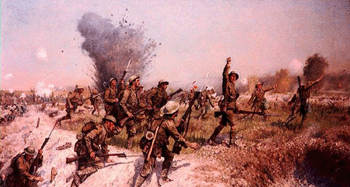
The Battle of Albert (first phase of the Battle of the Somme 1916): The Ulster Division was one of those selected to make the initial assault. It was in X Corps, with 32nd Division - a New Army formation - on its right facing the height around the immensely fortified position of Thiepval, and the regular army 29th Division, recently arrived from Gallipoli, facing Beaumont Hamel on the other bank of the Ancre. The Ulster Division faced an uphill advance, with the objective of capturing a large strongpoint complex in the enemy lines, called the Schwaben redoubt.
The Division’s attack on 1 July 1916 has been covered by writers in immense detail, and has entered into Ulster folklore as a day of enduring memory. Overall the day was one of significant defeat for the British Army, when more than 57,000 men became casualties, of whom 20,000 were killed. However, it is often forgotten that three Divisions captured their objectives, and that several others while not doing so did perform exceptional feats. The Ulster Division was one of them: it captured and held for a considerable time the Schwaben Redoubt, despite virtually no progress being made by either Division on its flanks.
The Division was relieved on 2 July, having suffered 5,104 casualties of who approximately 2,069 died.
Volumes have been written about the Battle of the Somme, which continued until November 1916. The author of the 36th Divisional History, the noted military historian Cyril falls says this of it: “But – and of this there can be no shadow of doubt today – it laid the foundations of final victory. The German troops were never the same after it, while our young levies, dreadful as were their sacrifices, were to arrive at a far higher standard of military virtue”.
On 5 July the Division moved back to Rubempré, and five days later the Bernaville area, although the artillery remained in position. Replacement drafts began to arrive before the Division was moved north, to Flanders. Falls again: “On 12 July…Brigade marching from the station of Thiennes into Blaringhem. The least practiced eye could tell that to these men confidence was returning; that the worst of the horror they had endured had been shaken from their shoulders. They marched like victors, as was their right”.
The Division moved to the Saint Omer area, with the Brigade going into billets in Eperlecques. However, by the end of July, 108th Brigade had been moved by bus to Kortepyp Camp, south of Neuve Eglise, and Red Lodge on Hill 63, west of Ploegsteert. The rest of the Division soon followed and took up positions in the Messines-Wulverghem-Ploegsteert area, where they were to stay until the summer of 1917. The area was relatively quiet, but was soon to see a very major and successful operation. The major activity other than holding trenches was raiding.
The pace began to quicken on this front in the spring of 1917. A decision had been taken to conduct an operation that had been in planning for well over a year, as a large preparatory operation to a larger attack from the Ypres area. The Second Army, of which the Ulster Division was currently a part, arranged for two overwhelming advantages in the attack, the purpose of which was to capture the long ridge running south from Ypres to Armentieres, through the villages of Wytschaete and Messines. First, the most intense concentration of artillery managed by the Army (in the entire war) was assembled. Second, the blowing of nineteen immense mines under the key enemy positions would precede the attack. These had been prepared many months before, at an immense cost in terms of labour, by the Tunnelling Companies of the Royal Engineers. Training was also to be more intense and thorough than anything that had gone before, and staff work was to be meticulous. The preliminary bombardment opened on 31 May 1917.
BATTLES:
The Battle of Messines
The Battle of Langemarck (second phase of Third Battle of Ypres)
The Battle of Cambrai
The Battle of St Quentin (first phase of the First Battles of the Somme 1918)
The Actions at the Somme Crossings (first phase of the First Battles of the Somme 1918)
The Battle of Rosieres (third phase of the First Battles of the Somme 1918)
The Battle of Messines, 1918 (second phase of the Battles of the Lys)
The Battle of Bailleul (fourth phase of the Battles of the Lys)
The First Battle of Kemmel (fifth phase of the Battles of the Lys)
The Advance in Flanders
The Battle of Ypres 1918
The Battle of Courtrai
The Division was demobilised between January and June 1919, having suffered 32,000 casualties during the war.
| 
 A BIT OF HISTORY: